Reflection Report: My travel track in BEMM129 Digital Business module

Description: What happened?

BEMM129 Digital Business module is a course that uses FutureLearn MOOC and ELE to conduct online learning expertise and participate in discussion of questions, and uses blog writing on different topics and peer review as evaluation criteria. It is unique because its main form is online teaching and interactions through the media to generate peers. Therefore, I will perform detailed evidence-based reflection in this blog, and summarize it through video.

Figure 1: My learning process
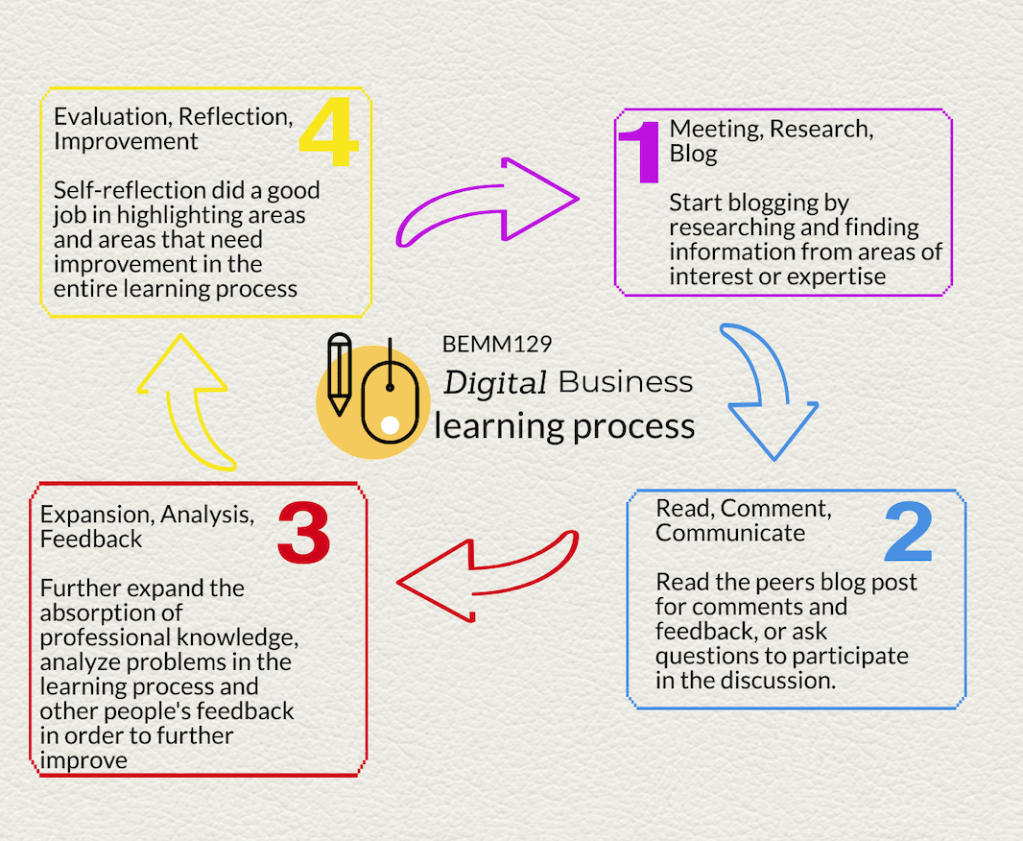
Created by Jin Wu 2020, using Piktochart

Evaluation: What are you thoughts and feelings & What went well and what did not?

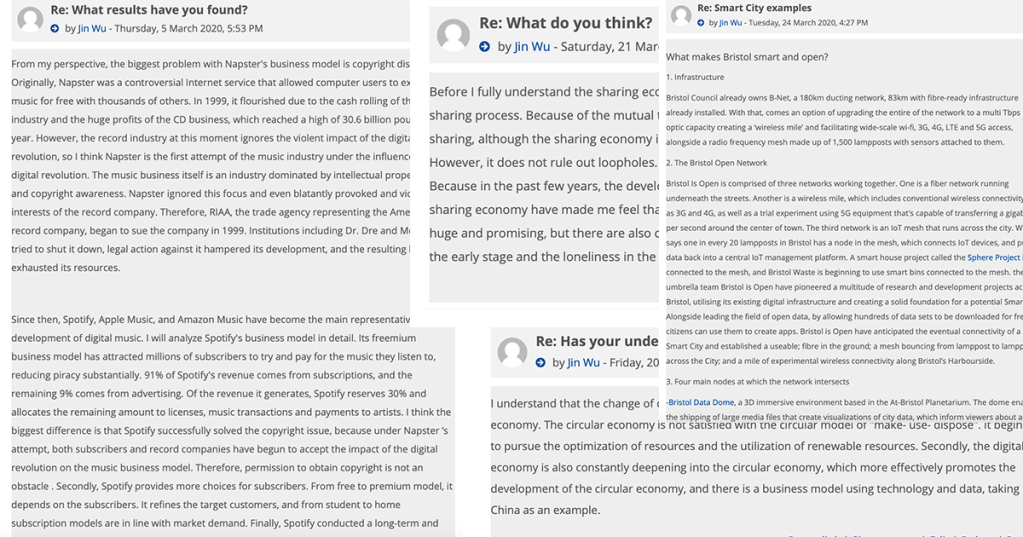
At the beginning, I was looking forward to this module and a bit worried because before that I was used to writing essays and reports and offline lecture and workshop. For me, this is a completely different learning module. It has a flexible learning mechanism. I realize that self-discipline and initiative are essential. This is exactly what I lack, so how to manage time properly is an obstacle. But once I started blogging in an area I loved, I was greatly satisfied. Especially in the process of researching and finding information, I once again recognized things from the perspective of digital commerce. For example, when discussing the smart city example on ELE, I can interpret Bristol’s intelligence from a digital and technological perspective. (Lisa Harris, 2020)

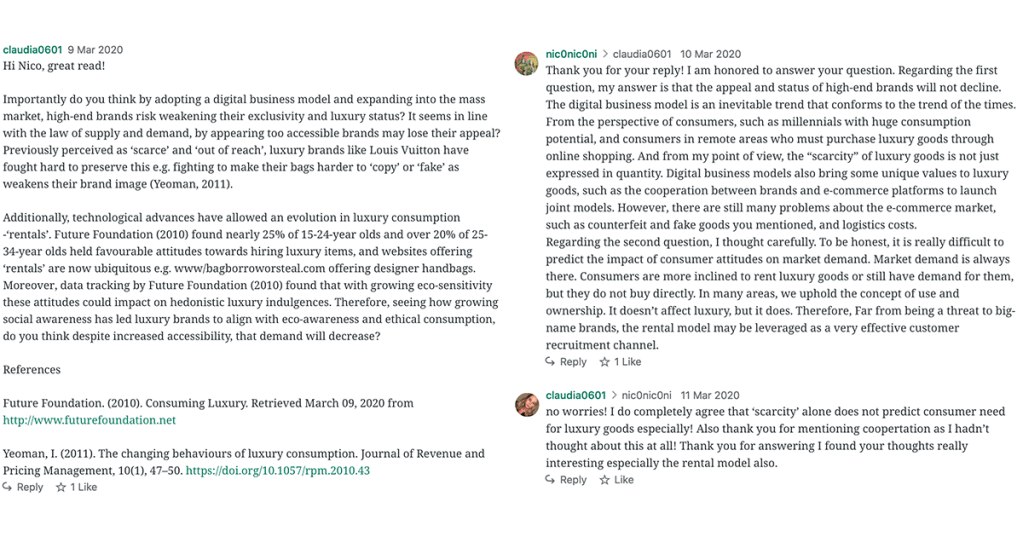
In addition, studying at FutureLearn MOOC gives me more possibilities for future studies and careers. This is a learning platform that brings together different backgrounds and identities, so diversified thinking has greatly expanded my thinking and I will always use the concept of lifelong learning as an incentive for future growth. Comments from peers on the blog also played an important role. For example, I discussed with Claudia in the second blog “Farfetch: A model for success through digital business models in Luxury Retail” whether the popularity of electronic business models will weaken the exclusiveness and commercial status of the luxury industry and the impact of electronics on luxury Changes in the product leasing market. The questions raised by Claudia in the comments extended my idea. Because the people who comment on my blog are mostly interested in blog content and may come from different fields, the questions they ask can to a certain extent bring me different levels of thinking direction and innovation inspiration. Different learning methods have made me experience the convenience and flexibility of digital learning, and the openness of online resource sharing and collaboration, which will also open the first door of the digital world for my future social network and digital employment environment. However, I think I lack the initiative in participating in the discussion and always forget to reply after thinking.

Figure 2&3&4: Detailed evidence on participation in MOOC, ELE and Blog comments
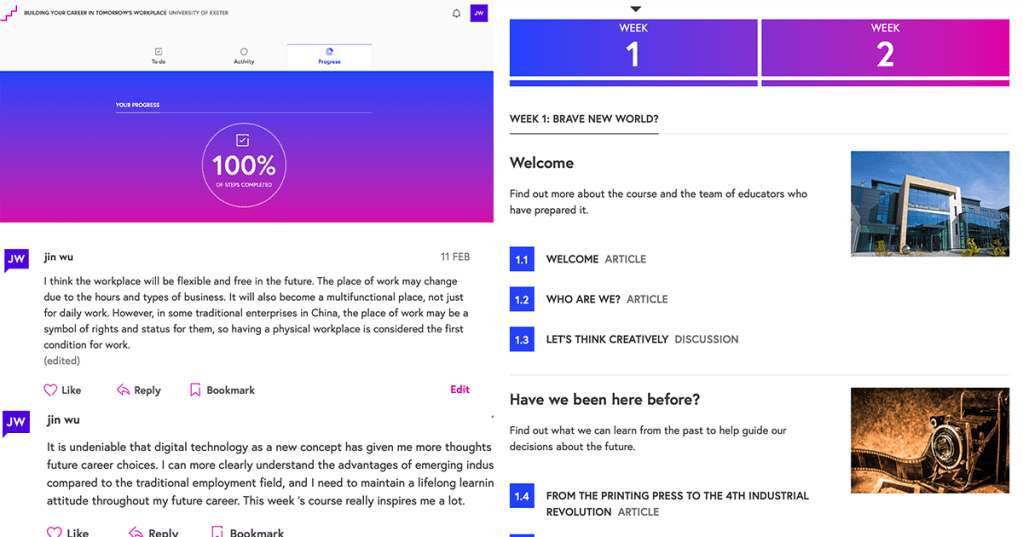

Created by Jin Wu 2020, using Photoshop

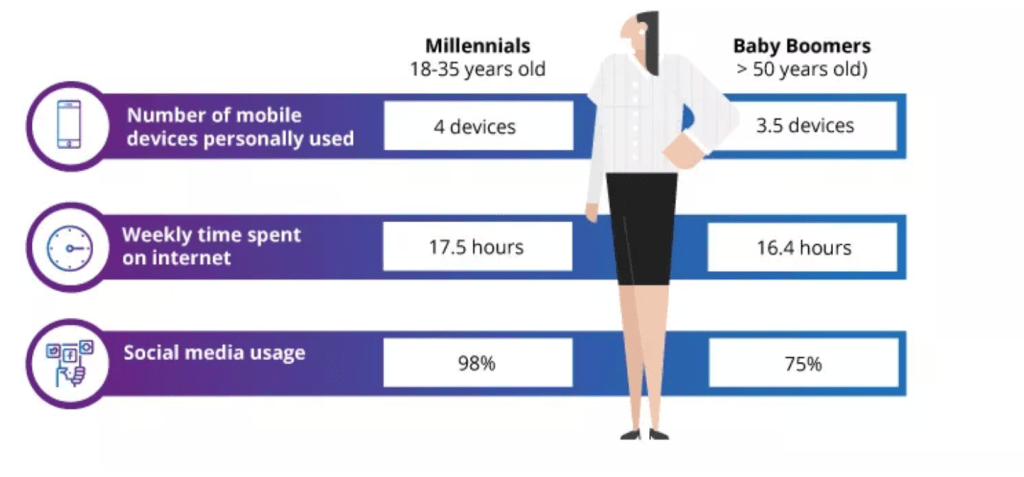
Figure 5:Changes in the cognitive process of digital business model
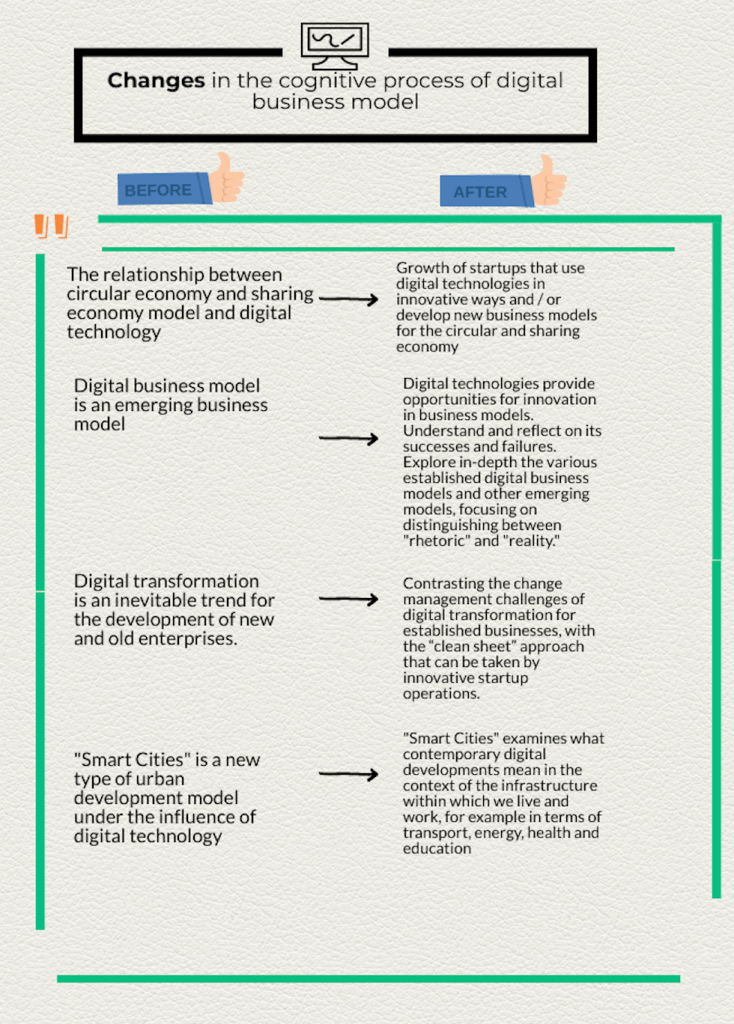
Created by Jin Wu 2020, using Piktochart

Action Plan: What would you do next time?

Figure 6 – Video showing Action Plan. Made Jin Wu 2020 using Biteable.com

Word count: 412

Works cited

Farfetch: A model for success through digital business models in Luxury Retail. [online] Available at: https://wordpress.com/read/feeds/102975445/posts/2614122410 [Accessed 30 Mar. 2020].

Lisa Harris. (2020) What makes a city “smart”? Available at: ELE (BEMM129) Digital Busines, Week 9 SMART CITIES (9/3) https://vle.exeter.ac.uk/mod/forum/view.php?id=1022685&forceview=1[Accessed 30 Mar. 2020].

Attachment: My comments
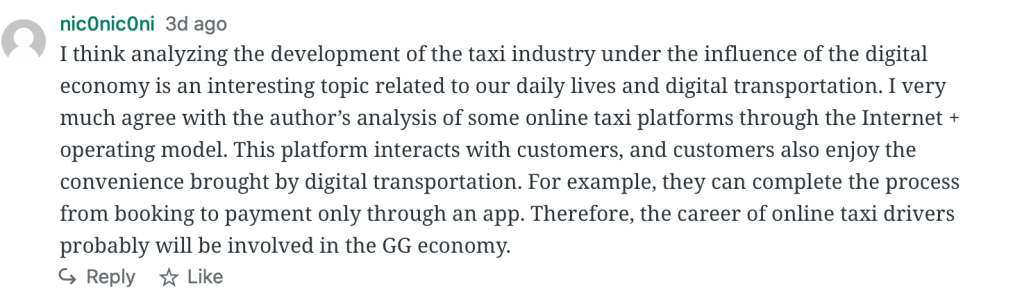
https://wordpress.com/read/blogs/172017043/posts/23
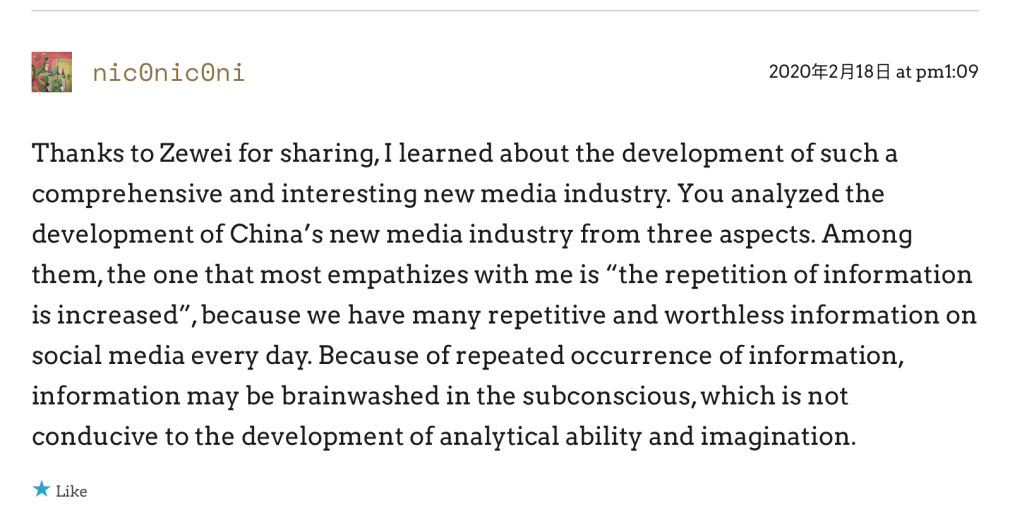
https://wordpress.com/read/feeds/103121908/posts/2614624449
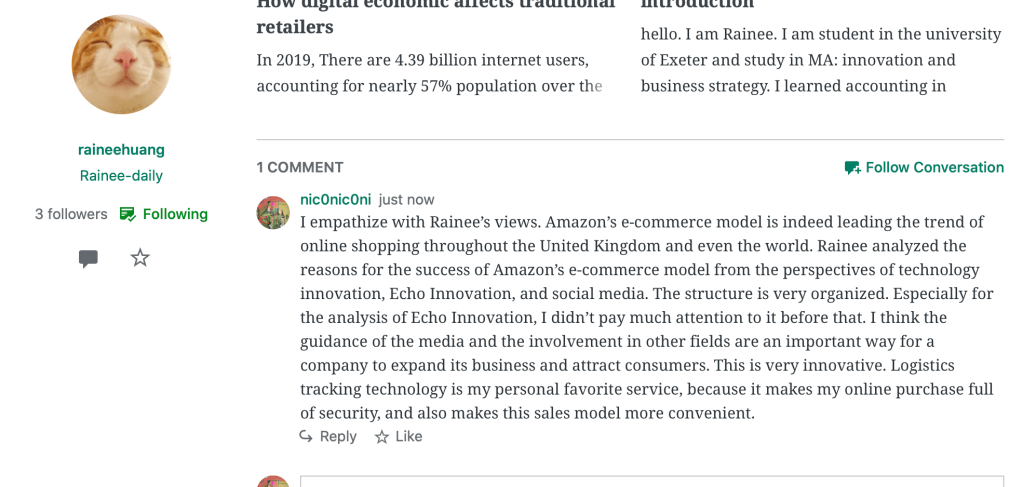
https://wordpress.com/read/feeds/103121908/posts/2614624449
Farfetch: A model for success through digital business models in Luxury Retail

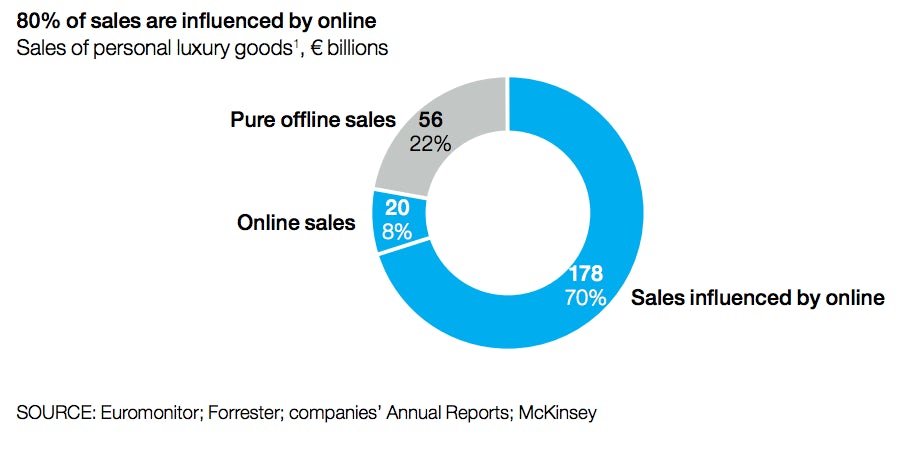
Are luxury brands missing the revolution in the digital economy? According to the report of McKinsey, 80% of luxury sales are now influenced by online. This is a staggering figure, and clearly highlights the important role digital now plays within a luxury purchase. (Wedgbury L, 2020) Consequently, I will take Farfetch as an example to analyze how its digital business model drives it to be in the front of technology fashion. Farfetch, created to address the specific problem that many high-end boutique retailers do not have the ability or resources to effectively manage online stores, revolutionized the market by creating an online hub. It not only provides an e-commerce platform for online business for brands. It also gives them access to their technology stack, ensuring they can better manage digital complexity. (Tuneva, G. , 2020) Customers can find and purchase high-end luxury products from various brands and designers in the hub. After the products are sold, Farfetch charges a sales commission.  

Figure 1: 80% of sales are influenced by online

Therefore, as a global technology platform for luxury fashion, Farfetch is positioned as a technology company. I define its digital model as technology oriented retail business model. I will analyze the contribution of digital business model to the success of Farfetch from three aspects: management model, target customer growth, loyalty and future market.

Management model

Farfetch’s management model is a technology-driven model. Bringing high end fashion online through technology, which does not rely on owning inventory. They platformized the supply chain and created a new business model around high profits and rapid turnaround, thus changing the retail fashion model in the process. (The Business of Fashion, 2020) Compared with the traditional decentralized and rapid luxury retail pattern, Farfetch is more like a market. Through establishing partnership with independent retailers, Farfetch directly delivers goods to most major cities in the world, so it does not need to store like a retailer. In this age of Amazon, which requires the creation of an omnichannel shopping experience, Farfetch has not integrated its Internet strategy into a mature retail business. Instead, it originated in the technology world and virtually attracted about 2 million global luxury shoppers through its digital means to support the daily operations and sales challenges of physical retailers. (Danziger P, 2020) “We are not a retailer. We are here to help brands and retailers find what the luxury experience is of 2020 and beyond. We want to be the platform for the global fashion industry, ” said Farfetch CEO and founder José Neves in an interview with Fast Company. (Finningley J, 2020)

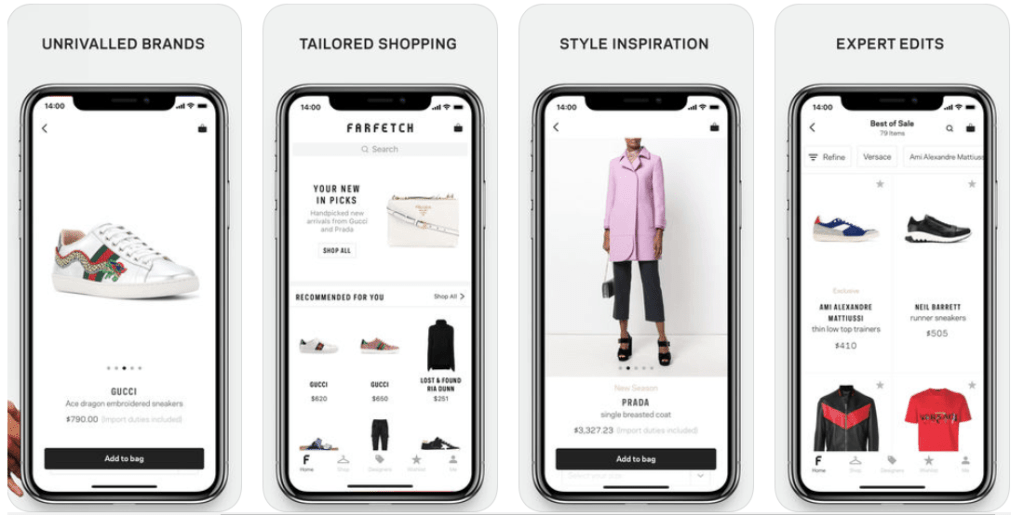
Figure 2: Farfetch’s Use interface (Tuneva G, 2020)

Target customer growth and loyalty

Farfetch’s mature use of the SMAC model to conduct market surveys of target customers found that millennials have a “digital first” way of thinking, and they are more willing to spend between GenZ on online spending capabilities accounting for 85% of the growth in luxury fashion sales in 2017. By 2025, millennials will surpass GenX and become the largest consumer group in the luxury sector. (Finningley, J., 2020) But from my cognitive perspective, the assumption that luxury shoppers will always love a tactile shopping experience with personalized customer service (to get the full value of money) has been challenged. Although the reason why digital luxury is increasingly important is mainly passed down from generation to generation, it is not only related to millennials, almost all luxury shoppers are keen to embrace the digital lifestyle. (Figure 3) Therefore, under the guidance of digital business model, Farfetch has greatly improved the number and quality of customers. For new customers, Farfetch’s service promise is exemplary, promising fast shipping, response time, 24/7 support, and free returns. The exclusivity of Farfetch products is another way to maintain customer loyalty, and 98% of retailers that partner with Farfetch have exclusive relationships with the brand. This ensures that products that shoppers see on Farfetch are unlikely to appear elsewhere on the web. (Digital.hbs.edu, 2020) As a result, Farfetch ensures that in-store one-to-one experiences are replicated and delivered online as much as possible.

Figure 3: Proportion of luxury shoppers (Business!, Z., 2020)

The development of future market

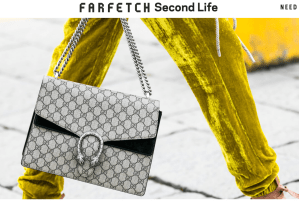
At the same time, the digital business model is also predicting its future market development trends. First, clothing, accessories and handbags dominate the resale market, with 68% of women already or willing to buy from the secondary market. As a result, Farfetch recently launched SecondLife. In addition, Farfetch is entering the Chinese market. The partnership between Farfetch and JD.com has not only enabled it to acquire the domestic proprietary technology of China ’s second largest e-commerce platform, but also allowed it to collaborate with China ’s top social media Tencent, the owner of the platform WeChat, established a connection, which gave Farfetch a huge lead in the Chinese market. (E Tail Boston 2020, 2020)

Figure 3: Farfetch SecondLife (website, 2020)

Works cited

Business!, Z. (2020). Digital Transformation Success Cases in Luxury Retail – Innovation Blog. [online] ZIGURAT Innovation School – Transform the way you do business!. Available at: https://www.e-zigurat.com/innovation-school/blog/digital-transformation-success-cases-in-luxury-retail/ [Accessed 6 Mar. 2020].

Danziger, P. (2020). Digital Luxury Fashion Marketplace Farfetch Is On A Roll To An IPO. [online] Forbes. Available at: https://www.forbes.com/sites/pamdanziger/2018/03/20/digital-luxury-fashion-marketplace-Farfetch-is-on-a-roll-to-an-ipo/ [Accessed 5 Mar. 2020].

Digital.hbs.edu. (2020). Farfetch.com: an E-commerce platform valued at $1 billion that is helping boutiques “globalizing” local shopping – Digital Innovation and Transformation. [online] Available at: https://digital.hbs.edu/platform-digit/submission/Farfetch-com-an-e-commerce-platform-valued-at-1-billion-that-is-helping-boutiques-globalizing-local-shopping/ [Accessed 5 Mar. 2020].

eTail Boston 2020. (2020). How Farfetch is Leveraging WeChat to Crack China’s Online Market. [online] Available at: https://etaileast.wbresearch.com/Farfetch-expanding-partnership-strategy-with-jd-leveraging-wechat-to-crack-china-online-market-ty-u [Accessed 5 Mar. 2020].

Finningley, J. (2020). Business Model Canvas – Farfetch. [online] Lumosbusiness.com. Available at: http://lumosbusiness.com/business-model-canvas-Farfetch/ [Accessed 5 Mar. 2020].

The Business of Fashion. (2020). Is fashion missing the technology revolution?. [online] Available at: https://www.businessoffashion.com/community/voices/discussions/is-fashion-missing-the-technology-revolution [Accessed 5 Mar. 2020].

Tuneva, G. (2020). How Farfetch used technology to bring high-end fashion online. [online] Essential Retail. Available at: https://www.essentialretail.com/comments/Farfetch-used-technology-fashion/ [Accessed 5 Mar. 2020].

Wedgbury, L. (2020). Why luxury brands need digital transformation – Econsultancy. [online] Econsultancy. Available at: https://econsultancy.com/digital-transformation-for-luxury/ [Accessed 5 Mar. 2020].

Exploring the development path of the fashion designer under the digital economy

The impact of the digital economy is gradually penetrating into the fashion designer industry. From my perspective, the influence on the production and design process of fashion products is the most extensive. To some extent, the digital economy may have led the transformation and upgrading of the design process compared with the traditional design process. Secondly, I believe that the digital economy has also changed the design concept and idea of fashion designers. Therefore, I will analyze the changes of fashion designers in the digital economy from the above two aspects, as well as predict its future development changes and trends.

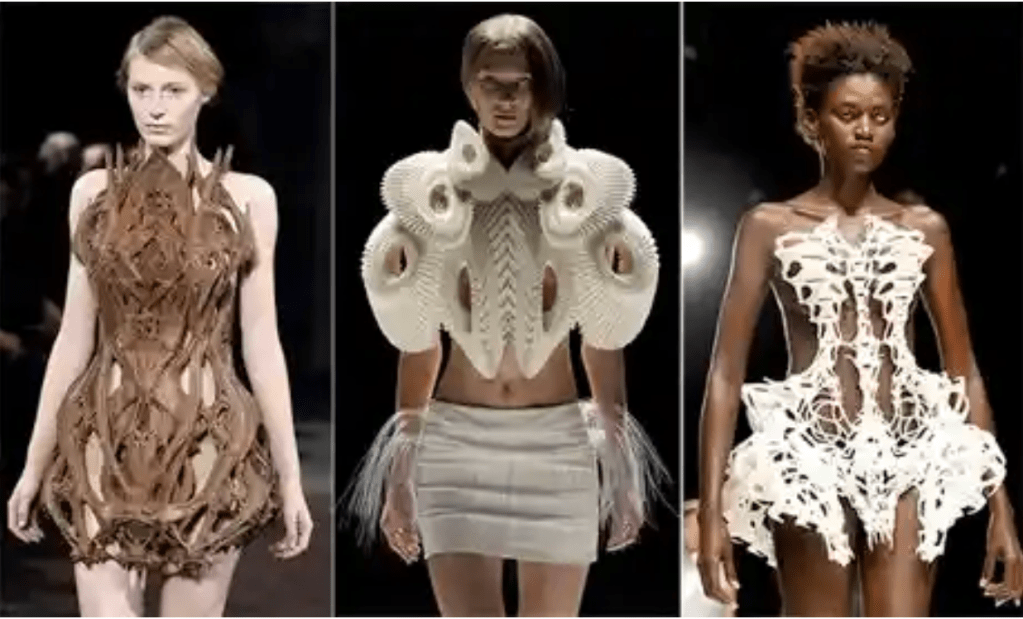
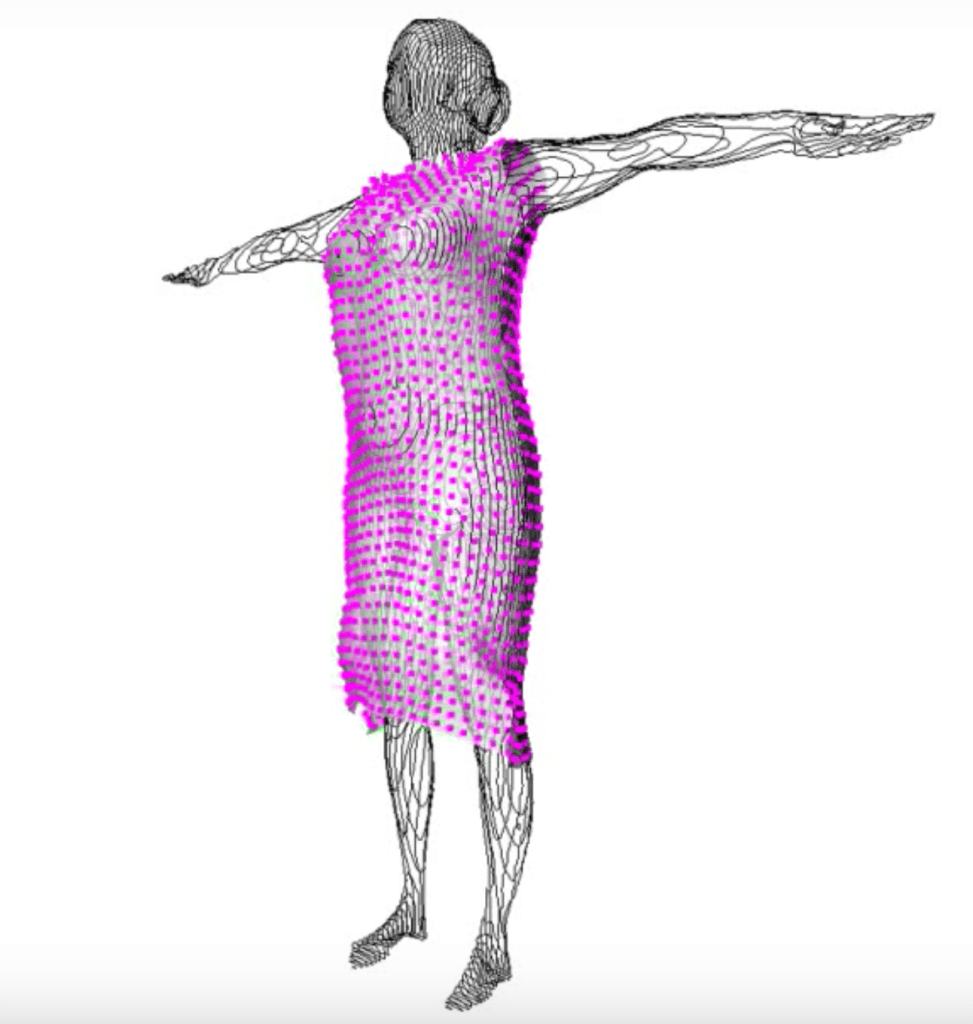
The 3D technology of fashion industry is regarded as a revolutionary and subversive technology. Due to the limitation of materials, 3D printed clothing fabric has poor wearability and far less color than traditional fabric. However, it can bring infinite creative inspiration to designers. Firstly, 3D printing technology can be produced at will according to the designer’s idea, truly realizing personalization. Then it is a one-time molding, rapid manufacturing, and eliminating multiple processes of traditional technology. Using the method of quantity increase rather than the traditional method of quantity decrease, saving raw materials, basically no waste. With the rapid development of 3D printing technology, the continuous research and development of new textile materials, combined with 3D anthropometry, CAD and other technologies, the “single measurement and single cutting” of automation will be realized in the future. In the future, customers can print their required textile and garment products at home or anywhere. (Arribas V, Alfaro J, 2018) Body scanning systems use light beams to generate 3D images from point cloud data and provide highly accurate body measurements. This data has been applied to the creation of anthropometric mannequins and virtual avatars, used for design and marketing visualisations and new virtual-try-on solutions.

Figure 1: 3D printing technology (Fisher A, 2020)

Figure 2: 3D anthropometry (Aniwaa, 2020)

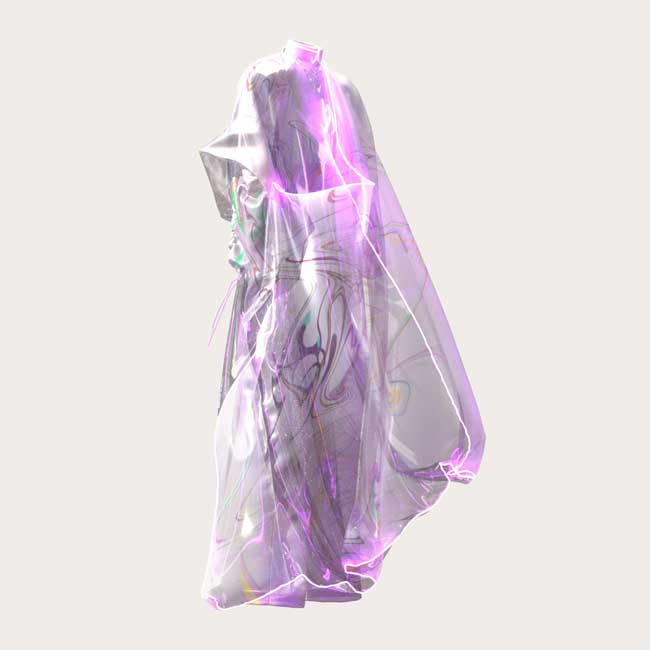
The Internet is a approach to bring people from different backgrounds around the world into the fashion trend of digital clothing. As long as you have a device, you can take advantage of this network and use technology to connect with all of us, which is a real democratic platform for identity and expression through digital means. (Crewe L, 2013) So some designers began to create digital fashion. Amber Jae slooten, who put forward the idea of Thought couture, officially released The Fabricant in 2018. (ThePowerHouse,  2020) Thought couture is basically digital Couture that is added to the blockchain, with the idea of making people think about the impact that it has, and what is behind it all. Digital fashion is a complete way of self-expression, without the limits of size, body type, gravity and other factors. (ELLE, 2020)

Figure 3&4: Thought couture (ThePowerHouse, 2020)

Sustainable fashion is becoming the mainstream of leading fashion industry. In the future career development of fashion designers, the concept of sustainability will be applied in the design process in combination with the digital economic model. It’s no secret that our fast fashion habit is causing irreparable damage. Clothing emissions exceed the combined value of all shipping and international flights. Now there is a broader push to make the fashion industry less disruptive and digital trends are helping. Sustainability is increasingly seen as a business opportunity and there is a call to equate the term “sustainability” with the success of the industry. (Mougey K, 2020) The demand for ethical clothing has increased exponentially, with 66% more searches for “sustainable fashion” occurring since 2018, according to fashion search engine Lyst. Therefore, digital tailors will emerge as a branch of designers in the fashion industry, which is a very novel way of working. Digital tailor will use the high flexibility and inclusiveness of digital clothing to meet the changing needs of consumers. Digital clothing is virtual and digital, and all its production process depends on technology. Therefore, designers need to be proficient in 3D technology and modeling technology. Compared with the traditional fashion design, digital clothing is like carving on the customer’s body, rather than creating patterns and sewing them together. So the main work of digital tailor is to use 3D measurement technology and modeling technology to create virtual clothing to achieve a high degree of fit between body and clothing. After purchasing, customers can publish photo clothing on social platforms. Of course, this service is aimed at customers who have a high pursuit of fashion trends. For them, clothing nowadays is more like an art form for social media. Fashion designers will continue to advance with the digital economy, which will bring more creativity and inspiration to designers.

Works cited

Arribas, V. and Alfaro, J. (2018). 3D technology in fashion: from concept to consumer. Journal of Fashion Marketing and Management: An International Journal, 22(2), pp.240-251.

Aniwaa. (2020). The best 3D body scanners in 2020 – Reviews and buying guide. [online] Available at: https://www.aniwaa.com/best-of/3d-scanners/best-3d-body-scanners/ [Accessed 12 Feb. 2020].

Crewe, L. (2013). When Virtual and Material Worlds Collide: Democratic Fashion in the Digital Age. Environment and Planning A: Economy and Space, 45(4), pp.760-780.

ELLE. (2020). Influencers Are Now Buying Virtual Clothes They Will Wear On IG But Never Touch IRL. [online] Available at: https://www.elle.com/uk/fashion/a28166986/digital-fashion-dressing-virtually/ [Accessed 12 Feb. 2020].

Fisher, A. (2020). 3D-printed fashion: off the printer, rather than off the peg. [online] the Guardian. Available at: https://www.theguardian.com/technology/2013/oct/15/3d-printed-fashion-couture-catwalk [Accessed 12 Feb. 2020].

Mougey, K. (2020). Digital trends reshaping the business of fashion. [online] LiveArea. Available at: https://www.liveareacx.com/blog/5-digital-trends-reshaping-the-business-of-fashion/ [Accessed 12 Feb. 2020].

ThePowerHouse. (2020). The future of self-expression: What digital fashion? by Amber Jae Slooten of The Fabricant – ThePowerHouse. [online] Available at: https://thepowerhouse.group/digital-fashion-amber-jae-slooten-the-fabricant [Accessed 12 Feb. 2020].

HI, I’M HERE! ^^

Hi everyone, this is Nico. Welcome to my little channel.

I am a student of MA creativity in Exeter University. My undergraduate major is finance and taxation. So I think I’m a creative business student. In fact, I don’t know how to define myself. I love vintage, platform shoes, purple, black and myself. Here, I will share some fun including my dress inspiration and life diary. Of course, I also will share the experience from digital business.

Looking forward to a deeper study of digital business module.

Looking forward to become stronger.

Nice to meet you!

💜

通过 WordPress.com 设计一个这样的站点
从这里开始